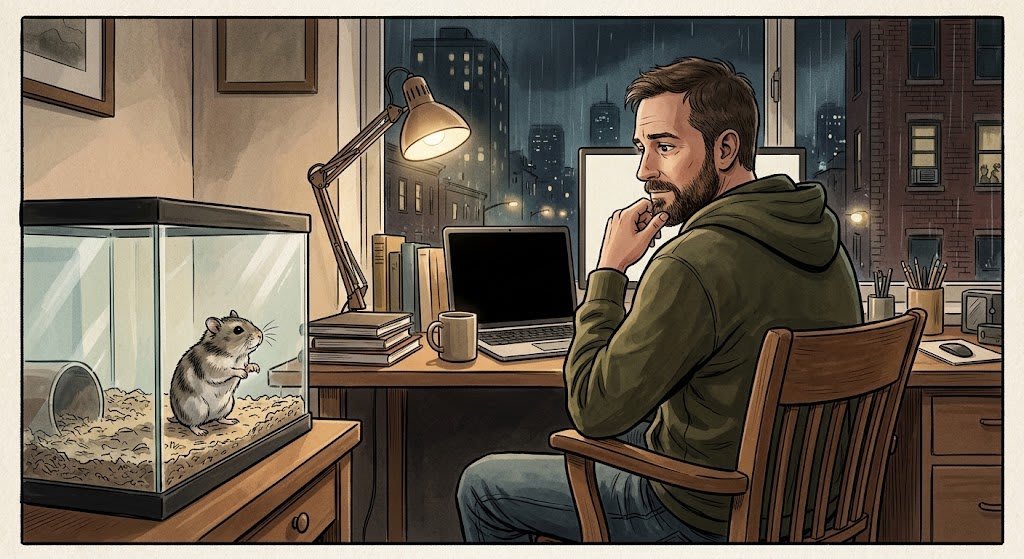
When working with clients struggling with anxiety, I often notice a familiar pattern: a tendency to overanalyze past decisions, almost always in a negative light.
Whether it’s choosing between job opportunities, navigating a romantic relationship, or making a major life change, the pattern is the same. If the choice turns out badly, they excoriate themselves. This reinforces a harmful self-narrative: “I make poor choices. I always do the wrong thing. Things always turn out badly for me.”
This pattern strongly resembles a concept frequently used in poker called “results-oriented thinking.”
What is Results-Oriented Thinking?
Results-oriented thinking is our human tendency to evaluate the quality of a decision based solely on its outcome.
When we do this, we minimize one of the most significant factors influencing life: chance, luck, or fate. Whatever you choose to call it, the reality is that some of the most critical factors affecting our lives are completely out of our control.
So, what can we control? Only the factors and information we take into consideration before we make our choice.
The Job Offer Paradox: A Real-World Example
Imagine you’re facing a choice between job offers at two different companies. You carefully analyze your options, write out a pros and cons list, evaluate potential career trajectories as best you can, and make your decision.
Two months later, two completely different scenarios unfold:
- Scenario A: The company you turned down gets bought by a conglomerate and flourishes.
- Scenario B: The company you chose files for bankruptcy and closes its doors.
If you chose the company that flourished, you’d likely feel smart, confident, and validated in your decision-making. But if you chose the company that went bankrupt, you’d likely beat yourself up for making the “wrong” choice.
The truth? You made the best decision you could with the information you had at the time. It wasn’t inherently a “good” or “bad” decision—it was simply the most informed choice available to you at that moment.
What Poker Teaches Us About Life and Anxiety
In poker, rational, logical decisions directly increase your odds of winning. But ultimately, there is an unavoidable element of luck.
You might have a 99% statistical chance to win a hand based on putting all your chips in the middle. You made the mathematically perfect play. But if that 1% outcome hits and you lose all your chips, you’re naturally going to feel terrible.
Do you wish you could go back in time and change your decision knowing how the hand played out? Of course! But that requires predicting the future—which is impossible.
The irony is that we often treat ourselves as if we should have known what was going to happen. That gap is where so much anxiety, guilt, and regret live. We are essentially punishing ourselves for lacking foresight into an unpredictable world.
Breaking the Cycle: Don’t Let Outcomes Dictate Your Self-Worth
Evaluating choices strictly by their results sets us up for psychological traps on both ends of the spectrum:
- When poor preparation leads to success: We learn the wrong lesson—that coasting or rushing works—and we bring that complacency to our next big decision.
- When thorough preparation leads to failure: We assume our effort was useless, concluding, “Why bother trying my best if I fail anyway?”
We can’t let short-term outcomes dictate how we approach our future. We can’t be afraid to fail, and we can’t get lulled into complacency by unexpected wins.
Focus on the Process, Not Just the Chips
In the poker game of life, there is plenty you can control—and even more that you can’t.
All you can do is put in the energy, gather the facts, and make the best choice available with the information you have at that moment. If you win, great! If you don’t, rest easy knowing you played the hand correctly, and trust that luck balances out over time.
Keep making sound decisions, give yourself grace when chance intervenes, and eventually, you’ll be the one stacking the chips.
Struggling with Overthinking and Decision Anxiety?
If you find yourself stuck in loops of regret or constantly second-guessing your life choices, therapy can help you build confidence in your decision-making process.
Ready to take the first step towards clarity and strength?
Let’s connect—schedule your free consultation with me today!